
A Glittering Requiem for Youth, Vanity, and the Beautiful Lie of Forever
Broadway has always loved a beautiful woman who refuses to age. It loves her even more when she is punished for it.
Death Becomes Her, now reborn as a Broadway musical, arrives like a champagne flute carried through a funeral—sparkling, audacious, and faintly dangerous. It is lavish and wicked and unapologetically obsessed with beauty, youth, rivalry, and the terror of disappearing. But beneath the rhinestones and punchlines, this production understands something crucial: our fixation on staying young has never been more desperate, more commercialized, or more heartbreaking than it is right now.
This musical is not merely a camp resurrection of the beloved 1992 cult film. It is a mirror held up to our current moment—one filled with injectables, filters, anti-aging regimens, curated identities, and the quiet panic of being replaced. And somehow, impossibly, it manages to be both hysterically funny and strangely moving.
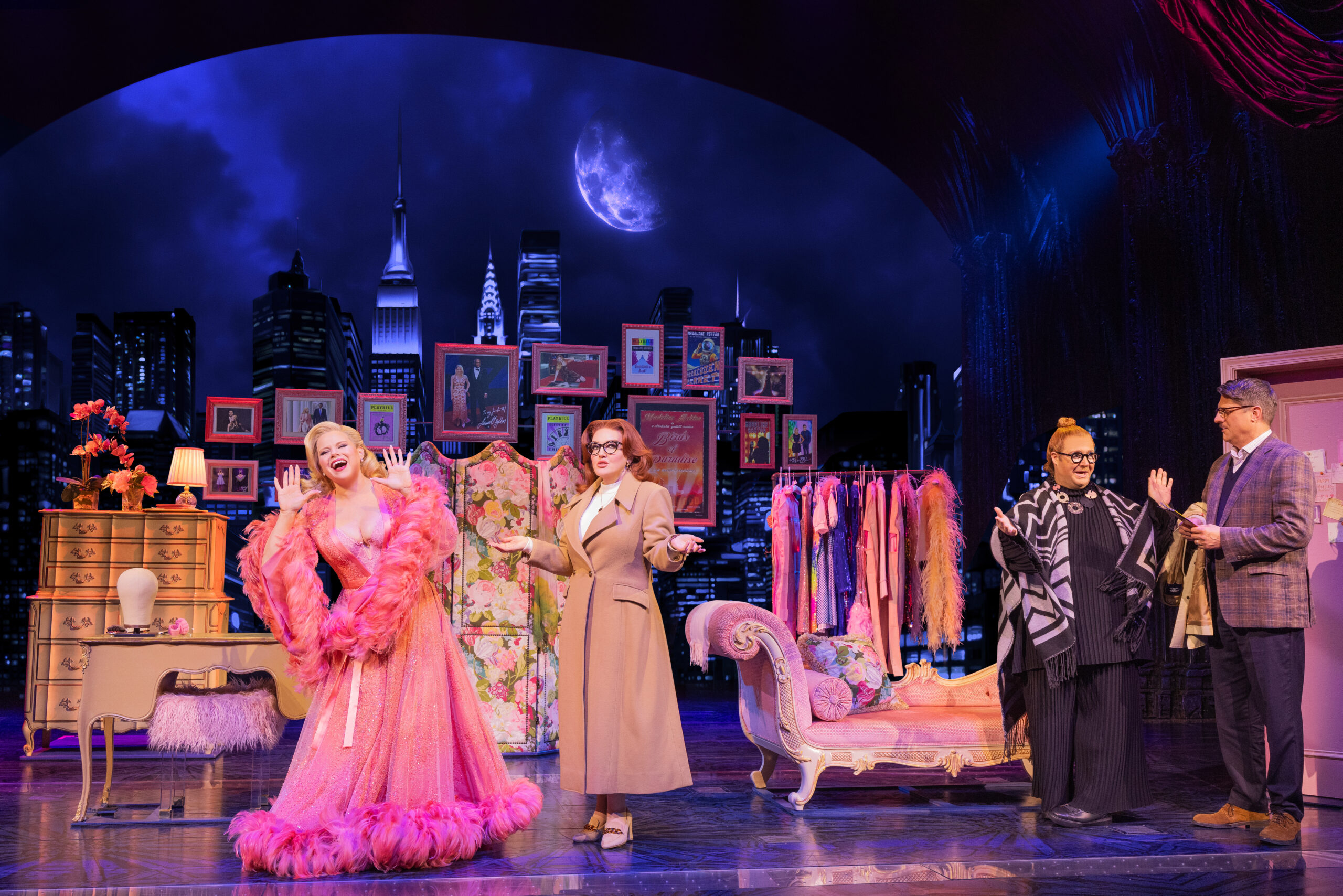
From the moment the curtain rises, Death Becomes Her announces its intentions clearly: this is not realism; this is myth. This is fairy tale. This is glamour with teeth.
At its core, Death Becomes Her is a fable about two women—Madeline Ashton and Helen Sharp—locked in a lifelong duel fueled by beauty, jealousy, and a shared refusal to accept time’s authority. They are rivals not only for men, careers, and admiration, but for relevance itself. Their obsession leads them to a mysterious elixir promising eternal youth, with one small caveat: you can never die.
The musical leans fully into the operatic nature of this premise. The stakes are absurd, the emotions oversized, and the aesthetic gloriously heightened. But what gives the story its bite is not the magic potion—it’s the emotional truth underneath it. These women are not afraid of death. They are afraid of becoming invisible.
And that fear, especially now, lands with a thud.
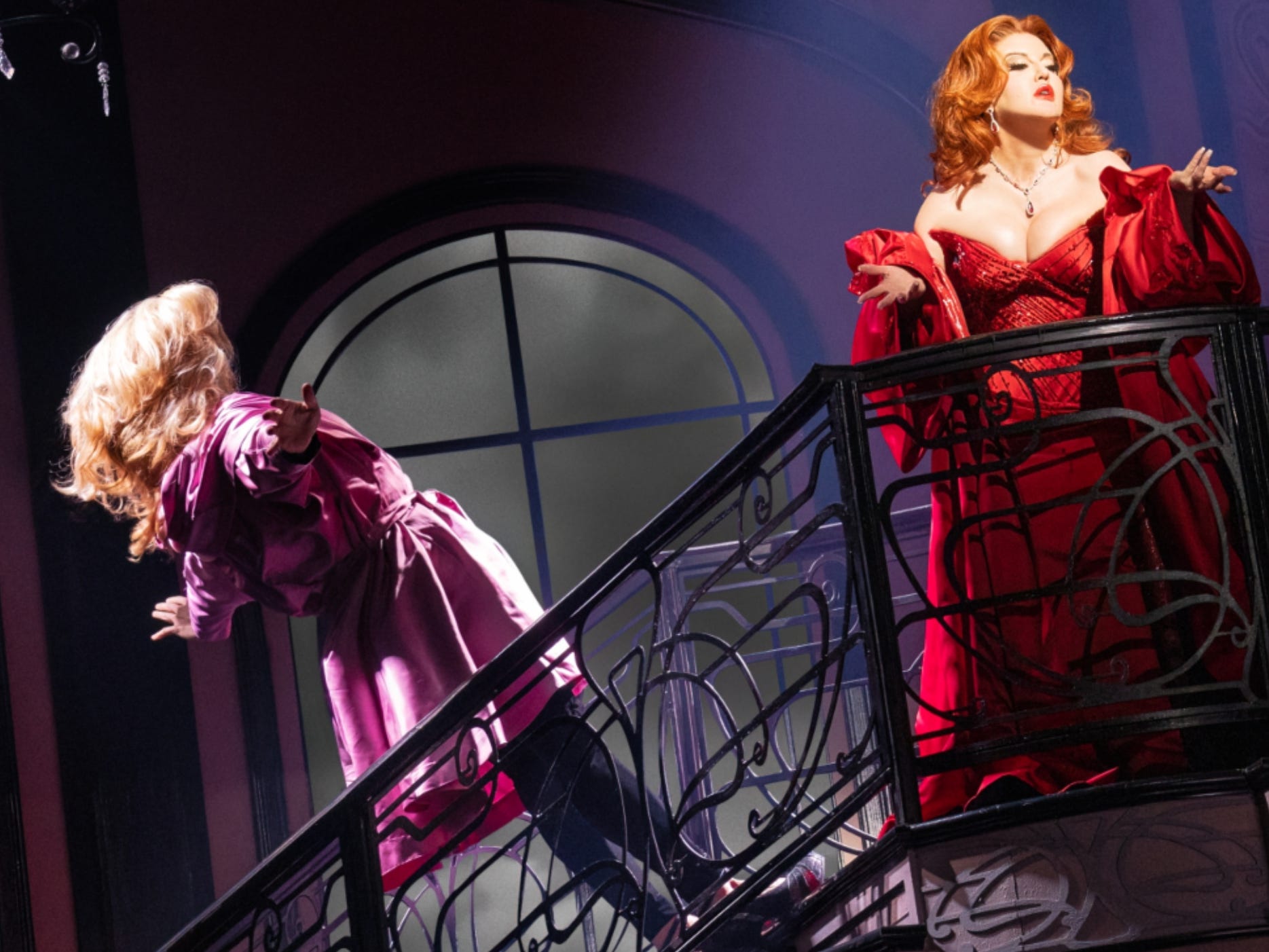
The great triumph of this production is its tonal precision. Death Becomes Her understands camp not as silliness, but as exaggeration in service of truth. The humor is sharp, self-aware, and deliciously unhinged. The audience laughs—constantly—but it is a laughter laced with recognition.
The book crackles with wit, often skirting the edge of cruelty, then stepping right over it. The jokes are fast, referential, and unapologetically theatrical. There is no attempt to modernize the story into something sleek or sanitized. Instead, the musical amplifies its excesses, trusting the audience to keep up.
This is Broadway at its most confident: unafraid of glamour, unafraid of ugliness, unafraid of women who are ambitious, petty, brilliant, and monstrous in equal measure.
The actresses inhabiting Madeline and Helen do not soften these women to make them palatable. That is the point. Madeline is dazzling, vain, and ruthless—her confidence a weapon sharpened over decades. Helen, initially more restrained, reveals a fury just as potent, her transformation one of the most satisfying arcs on stage.
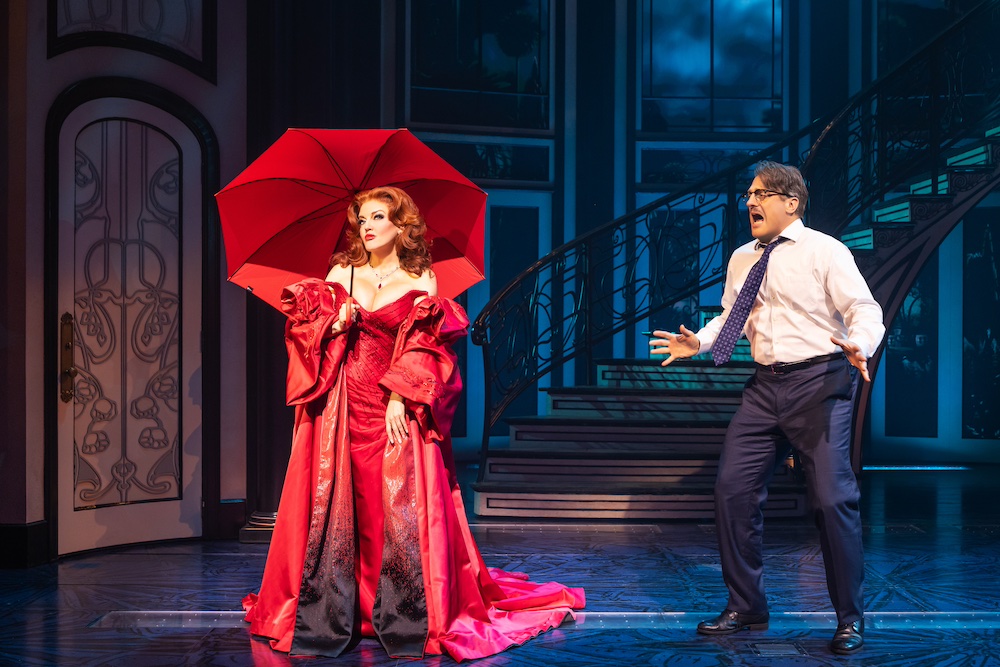
What makes these performances remarkable is not their comedic timing (which is impeccable), but their emotional intelligence. Beneath the bravado, both women betray moments of panic, regret, and aching vulnerability. There are flashes—brief, almost accidental—where the mask slips, and we see the cost of a life spent performing youth instead of living truth.
The men orbiting these women, particularly the long-suffering Ernest, are written not as saviors but as collateral damage. The musical wisely centers female desire, female rivalry, and female ambition without moralizing them. No one is redeemed. No one is punished neatly. Everyone survives—forever—whether they want to or not.
The score understands that spectacle alone is not enough. Yes, there are show-stopping numbers drenched in satire and bravura. Yes, there are melodies designed to elicit gasps, applause, and delighted disbelief. But the most effective musical moments are quieter.
There are songs here that linger unexpectedly, tracing the loneliness beneath the laughter. Numbers that allow characters to articulate what they would never say aloud: that beauty is a currency that expires, that love feels safer when it is transactional, that immortality is less a dream than a trap.
The music moves effortlessly between pastiche and sincerity, never mocking its own emotions. That balance—so difficult to achieve—is what elevates the show from parody to poetry.
Visually, Death Becomes Her is a feast. The costumes shimmer with intention, charting each character’s evolution through silhouettes that cling, constrict, and finally harden into armor. The set design plays with illusion and decay, glamour and rot, reinforcing the central paradox: eternal youth requires eternal maintenance.
The effects—both practical and theatrical—are executed with knowing flair. They are impressive not because they attempt realism, but because they celebrate artifice. This is a world where bodies break and bend, where death is reversible, where beauty is literally stitched back together.
And yet, for all its visual indulgence, the production never loses sight of the human cost beneath the spectacle.
There is something quietly radical about staging Death Becomes Her in this cultural moment. We live in an era obsessed with optimization—of faces, bodies, timelines, identities. Aging is treated not as a privilege but as a failure. Women, especially, are sold the fantasy that they can outrun time if they just try hard enough, pay enough, erase enough.
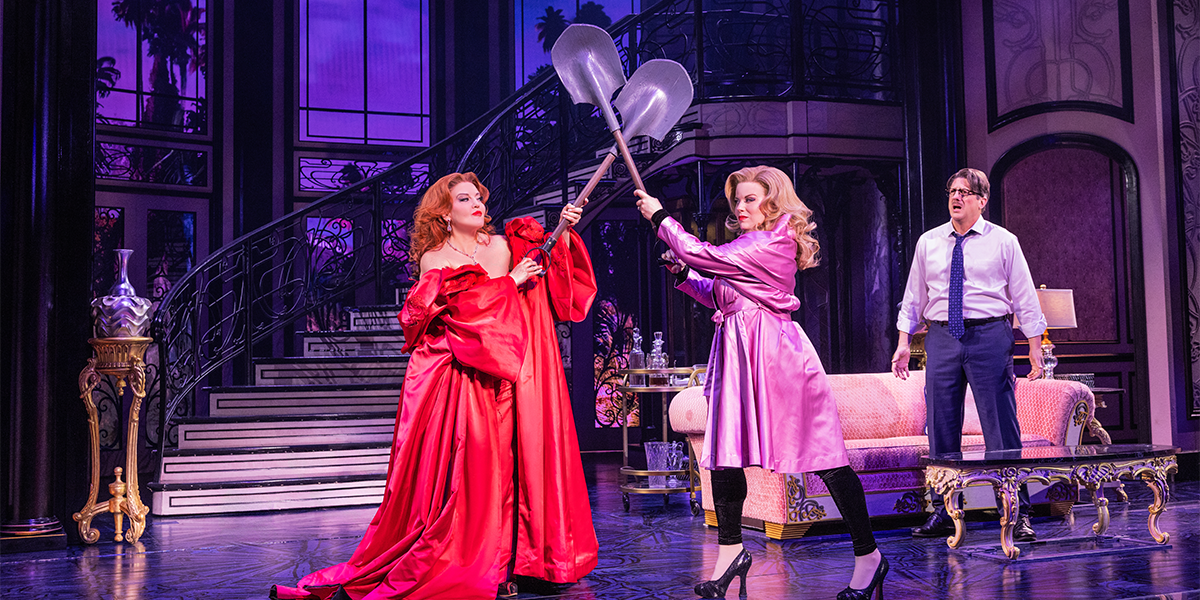
This musical exposes the lie at the heart of that promise.
Immortality, here, is not liberation. It is stagnation. To live forever is to remain trapped in the version of yourself you were most admired for—and most afraid to lose. Growth becomes impossible. Healing becomes irrelevant. Change becomes the enemy.
In one of the show’s most haunting undercurrents, the audience is invited to consider what truly makes a life meaningful: its length, or its willingness to end.
What makes Death Becomes Her so effective is that it never preaches. It seduces. It makes you laugh until you relax, until you drop your guard—then it slips its questions into your lap.
What would you give to stay young?
Who do you become when being desired is your primary proof of existence?
What happens when survival outlasts purpose?
These questions linger long after the curtain call, long after the applause fades.
Perhaps the most extraordinary achievement of this musical is its refusal to simplify women. Madeline and Helen are not role models. They are not cautionary tales. They are not victims or villains in any tidy sense. They are fully realized, contradictory, magnetic human beings.
Broadway has often struggled to allow women to be ambitious without punishment, aging without erasure, or unlikeable without apology. Death Becomes Her does all three—joyfully.
These women do not learn lessons. They do not repent. They endure. And in that endurance, the musical finds its strangest, sharpest truth.
When Death Becomes Her ends, it does not send you out humming only a tune. It sends you out with a feeling—something between delight and discomfort. You may catch your reflection in a theater mirror and wonder, briefly, what you would drink if offered the same promise.
That is the mark of a work that understands its audience intimately.
This Broadway incarnation is glossy, ferocious, and unexpectedly wise. It honors the film’s legacy while transcending it, using music and theater to deepen the story’s emotional resonance. It reminds us that comedy can be a vessel for existential dread—and that beauty, when worshipped too fiercely, becomes its own kind of curse.
Death Becomes Her is not about dying.
It is about refusing to live honestly.
And in that refusal, it becomes one of the most incisive—and entertaining—musicals Broadway has offered in years.
If immortality were ever sold with this much sparkle, who wouldn’t be tempted?
The brilliance of this show is that it lets you enjoy the fantasy—then gently, mercilessly, asks you to pay attention to the cost.
Words by Elle Taylor