How Patients Find Doctors in 2026: Google, AI Search, Social Media & the New Rules of Medical Marketing
Google is no longer the only place patients search. The modern patient journey now moves through AI, social media, reviews, video, editorial authority and traditional search—often before a practice ever receives a phone call.
By Elena Vasilevsky | INLOVE Magazine
A patient looking for a plastic surgeon in Manhattan may never begin by typing “best plastic surgeon NYC” into Google.
She might be scrolling through Instagram when a surgeon appears in a Reel explaining a procedure she has been considering.
She watches.
Then she visits the doctor’s profile.
She searches the physician’s name on Google, reads patient reviews, looks at before-and-after photographs and visits the practice website.
Later, she asks an AI assistant a question about the procedure.
She watches another doctor’s explanation on YouTube.
She returns to Google.
And only then does she schedule a consultation.
Welcome to the new patient journey.
For years, medical marketing revolved around a relatively straightforward objective: rank prominently on Google for the services patients were searching for.
Google remains extraordinarily important. But in 2026, the path between “I am considering a treatment” and “I am booking this doctor” has become far more complex.
Search hasn’t disappeared.
Search has fragmented.
Patients now discover, investigate and validate physicians across an interconnected ecosystem that can include Google Search, Google Maps, AI-powered search experiences, Instagram, TikTok, YouTube, online reviews, medical websites, digital publications and other sources of authority.
For physicians and medical practices, this shift requires a new way of thinking about visibility.
Being discoverable is no longer enough.
You have to be credible wherever the patient looks next.
How Patients Find Doctors in 2026: The New Patient Journey
Consider how dramatically the meaning of “search” has changed.
A prospective patient might type:
“dermatologist for hair loss near me”
into Google.
But that same person might ask an AI platform:
“What type of doctor should I see for sudden hair loss?”
Another patient may discover a treatment while watching an Instagram Reel.
Someone considering breast augmentation may spend weeks consuming educational videos before searching for an individual surgeon.
A dental patient experiencing pain may go directly to Google Maps and look for an endodontist nearby.
These aren’t separate marketing worlds.
They are different entrances into the same decision-making journey.
That is why modern medical marketing must be approached as an ecosystem rather than a collection of disconnected platforms.
Your website tells one part of the story.
Google tells another.
Your reviews contribute another layer.
Your social media establishes familiarity.
Video demonstrates how you communicate.
Editorial coverage can strengthen outside authority.
And increasingly, AI-powered discovery may influence which sources and physicians become part of a patient’s research process.
The strongest medical brands create consistency across all of them.
Google Still Matters—Enormously
The rise of AI does not mean traditional SEO is obsolete.
Quite the opposite.
Google has stated that the fundamentals of SEO remain relevant to its generative AI search experiences, including AI Overviews and AI Mode. Pages still need to be accessible, indexable, useful and eligible to appear in Google Search.
For medical practices, that means the fundamentals still matter:
- A technically healthy website
- Clear service and procedure pages
- Accurate physician information
- Useful educational content
- Strong internal linking
- Location relevance
- High-quality images and video
- Appropriate structured data
- A complete Google Business Profile
- A healthy review presence
- Consistent information across the web
For local medical practices in particular, Google Business Profile remains critical.
Google explains that local rankings are primarily influenced by relevance, distance and prominence. Complete business information, reviews, links and the overall prominence of a business can all contribute to local visibility.
So no, doctors should not abandon Google for AI.
They should strengthen their Google presence while expanding the definition of search.
The Rise of AI Search
One of the most consequential changes in digital discovery is that people can now ask increasingly detailed questions rather than reducing their needs to a few keywords.
Instead of searching:
“Botox Bergen County”
someone might ask:
“What should I look for when choosing a dermatologist for cosmetic injectables?”
Instead of:
“root canal Midtown Manhattan”
the question may become:
“I have severe tooth pain but my X-ray looks normal. Could I still need a root canal?”
And instead of:
“mommy makeover NYC”
a patient may ask:
“What procedures are typically combined in a mommy makeover after pregnancy, and how do I choose a qualified plastic surgeon?”
These are fundamentally different search behaviors.
Google’s AI Mode is designed specifically for more nuanced questions and complex comparisons. Google says these systems can use a process sometimes called “query fan-out,” performing multiple related searches across subtopics and sources to develop an answer.
That creates an important opportunity.
A medical practice does not necessarily need to own one short keyword to become relevant to a patient’s journey.
It needs to develop enough useful, authoritative and clearly structured information around its areas of expertise that search systems can understand what the physician knows, what the practice does and when its content may be relevant.
What Is GEO—and Does a Doctor Need It?
The marketing world has quickly adopted terms including GEO, or Generative Engine Optimization, and AEO, or Answer Engine Optimization.
The terminology may be new.
The underlying principle is less mysterious.
A physician wants their expertise and digital presence to be understandable and discoverable as people increasingly use AI-powered systems to research health, treatments, providers and services.
But there is an important distinction.
There is no magic switch that guarantees a medical practice will be recommended by ChatGPT, Google AI Mode or another AI system.
And no ethical agency should promise one.
Google itself states that websites do not need special AI files or special schema simply to qualify for its AI search features. Its recommendation remains rooted in established SEO fundamentals and valuable, original content.
So effective AI-search strategy should not be about manipulating an algorithm.
It should be about creating a stronger digital authority footprint.
That means clearly communicating:
Who is the doctor?
What are their credentials?
Where do they practice?
What do they specialize in?
What procedures do they perform?
What questions can they answer exceptionally well?
What evidence exists outside their own website that supports their authority?
The clearer and more consistent that digital identity becomes, the easier it is for both people and search systems to understand the physician.
Social Media Has Become Part of Search
For medical practices, Instagram, TikTok and YouTube should no longer be viewed exclusively as social platforms.
They are discovery platforms.
A dermatologist explaining why hair shedding may occur after significant weight loss isn’t simply “making content.”
The physician is answering a question a prospective patient may already be researching.
An endodontist explaining why persistent pain can exist despite an apparently normal X-ray isn’t merely producing a Reel.
That physician is demonstrating expertise before the patient ever enters the office.
A plastic surgeon discussing the difference between two surgical approaches isn’t simply trying to generate views.
The surgeon is allowing a prospective patient to experience how they educate, communicate and think.
That matters because medicine is built on trust.
The most valuable medical content therefore doesn’t simply announce:
We offer this procedure.
It answers:
Why would someone need it?
Who might be a candidate?
What misconceptions exist?
What should patients understand?
What questions should they ask?
Educational content transforms a physician from a name in a search result into a recognizable authority.
Visibility Is Not the Same as Authority
This distinction may be the most important one in modern medical marketing.
You can buy visibility.
You can boost a post.
You can run an advertisement.
You can purchase clicks.
But authority has to be built.
When prospective patients encounter a physician repeatedly—through useful Google results, strong reviews, thoughtful articles, compelling videos, professional photography, media features and a sophisticated website—a cumulative perception begins to form.
The patient starts thinking:
I’ve seen this doctor before.
Then:
This doctor seems knowledgeable.
Eventually:
This may be the doctor I want to see.
That progression is enormously valuable.
Modern medical marketing isn’t simply about generating impressions.
It is about creating enough credible touchpoints that recognition evolves into trust.
Why Original Medical Content Matters More Than Ever
The internet is saturated with generic medical content.
“Five Benefits of Botox.”
“Seven Reasons to Consider Invisalign.”
“Everything You Need to Know About Hair Loss.”
Thousands of nearly interchangeable articles can answer those questions.
That makes generic content increasingly less valuable.
Google’s current guidance for generative AI search specifically encourages publishers to create unique, non-commodity content that provides original perspective or first-hand expertise rather than merely repackaging information that already exists everywhere online.
For physicians, that creates an extraordinary opportunity.
Doctors possess something generic content generators don’t:
Clinical experience.
A plastic surgeon can explain what patients commonly misunderstand during consultations.
A dermatologist can discuss patterns observed when evaluating patients with hair loss.
A dentist can explain the questions patients repeatedly ask about Invisalign.
An endodontist can describe why certain cases become diagnostically complex.
That is the content worth publishing.
Not because an SEO tool says a keyword needs 1,800 words.
Because it contains actual expertise.
And genuine expertise is ultimately what both patients and high-quality search systems are trying to find.
Google Business Profile: The Digital Front Door
For local medical practices, one platform deserves particular attention: Google Business Profile.
When someone searches for a physician, dermatologist, dentist, plastic surgeon or specialist nearby, the Google Business Profile may become one of the patient’s first encounters with the practice.
That means photographs matter.
Reviews matter.
Accurate categories matter.
Business information matters.
The website connected to the profile matters.
And the overall consistency of the practice’s digital presence matters.
Google explicitly identifies relevance, distance and prominence as primary factors in local search.
A practice cannot control where every prospective patient is physically located.
But it can work on the other signals.
It can clearly communicate what it does.
It can maintain accurate information.
It can encourage legitimate patient reviews.
It can respond professionally.
It can publish high-quality photographs and video.
And it can build a stronger presence beyond Google through its website, reputable publications and other relevant sources.
Local SEO isn’t one trick.
It is reputation translated into digital signals.
The New Medical Marketing Funnel
The traditional funnel was relatively simple:
Search → Website → Call
The 2026 patient journey may look more like:
Discovery → Curiosity → Search → Social → Reviews → Website → AI Research → Video → Search Again → Consultation
And sometimes the order is completely different.
That changes what a medical marketing agency should be responsible for.
Posting three attractive Instagram photographs per week isn’t enough.
Neither is ranking one webpage.
Neither is running advertisements without building the brand patients encounter after clicking them.
The strategy needs to connect the entire digital identity.
Search. Social. Editorial. Video. Reviews. Local visibility. Brand positioning. AI discoverability.
Because patients don’t experience a doctor’s marketing department by department.
They experience one doctor.
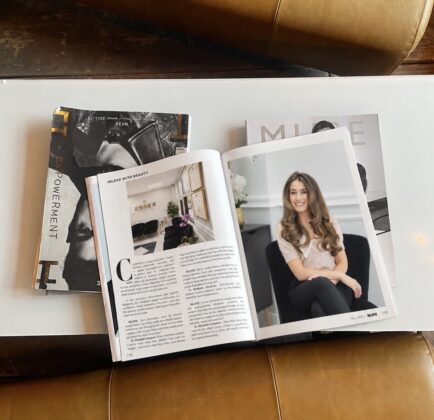
From INLOVE Magazine to INLOVE Creative: Why Editorial Thinking Matters
For more than a decade, INLOVE Magazine has operated at the intersection of culture, beauty, medicine, hospitality, personalities and storytelling.
That editorial background ultimately influenced the creation of INLOVE Creative, a marketing and creative agency working with medical, dental, aesthetic and hospitality brands.
The philosophy is simple:
Authority should never look like advertising.
A physician can be highly accomplished and still have a digital presence that fails to communicate that expertise.
The solution isn’t necessarily louder marketing.
Often, it is better storytelling.
A compelling physician portrait.
A 30-second explanation that answers exactly what patients want to know.
A Google result that immediately establishes relevance.
An article demonstrating genuine expertise.
A website that feels as sophisticated as the practice itself.
A consistent identity across search, social and editorial channels.
This is where publishing and marketing increasingly intersect.
The objective isn’t merely to make a doctor visible.
It is to make expertise visible.
What Should Medical Practices Do Now?
The practices best positioned for the next era of discovery will not chase every new platform.
They will build strong foundations that travel across platforms.
Start with the questions patients genuinely ask.
Create expert answers.
Build a website that clearly communicates services, physicians and locations.
Strengthen Google Business Profile.
Develop legitimate patient reviews.
Use social media to educate rather than simply advertise.
Produce original photography and video.
Publish physician expertise.
Build credible mentions and links beyond the practice’s own website.
And make sure the story patients encounter on Google is consistent with the story they encounter everywhere else.
Because the future of medical marketing isn’t about choosing between Google and AI.
It is about becoming discoverable, understandable and credible wherever the search begins.
Frequently Asked Questions
How are patients finding doctors in 2026?
Patients may discover and research physicians through multiple channels, including Google Search, Google Maps, practice websites, online reviews, Instagram, TikTok, YouTube, digital publications and AI-powered search experiences. The exact journey varies by patient, specialty, location and treatment.
Is SEO still important for doctors?
Yes. Google states that established SEO fundamentals remain relevant to its generative AI features, including AI Overviews and AI Mode. Useful content, crawlability, internal linking, page experience, high-quality images and accurate business information continue to matter.
What is GEO in medical marketing?
GEO commonly refers to Generative Engine Optimization: strategies intended to improve how clearly a brand or expert is understood and potentially discovered within generative AI search experiences. There is no guaranteed method for earning an AI citation or recommendation, and Google states that special AI-specific markup is not required for inclusion in its generative search features.
Can ChatGPT or AI recommend a doctor?
AI systems can provide information about doctors or practices depending on the product, available information, user query and system behavior. No medical practice can guarantee that it will be recommended by an AI platform. Practices should instead focus on accurate, authoritative and publicly accessible information across their digital presence.
Does social media help doctors attract patients?
Social media can contribute to discovery, education, familiarity and trust. Its effectiveness varies by specialty, audience, content and execution. For physicians, educational content can be particularly useful because it allows prospective patients to understand the doctor’s expertise and communication style before scheduling an appointment.
What helps a medical practice rank locally on Google?
Google identifies relevance, distance and prominence as the primary factors behind local results. Complete and accurate Business Profile information, reviews, links and broader web prominence can contribute to local visibility.
What is the best medical marketing strategy in 2026?
There is no single strategy that is best for every practice. A comprehensive approach may combine technical SEO, local SEO, Google Business Profile optimization, original educational content, physician-led video, social media, reputation management, editorial authority and measurement based on the practice’s specialty, market and patient goals.
The Search Has Changed. Authority Hasn’t.
Technology will continue to change the way patients discover physicians.
Platforms will evolve.
Search interfaces will change.
Algorithms will change.
But the fundamental question behind the search remains remarkably human:
Who do I trust?
The medical brands that understand that question will have an advantage regardless of where the next search begins.
Understanding how patients find doctors today requires looking beyond traditional Google search.
AI is also changing how patients find doctors, compare specialists, and evaluate medical expertise online.
Ultimately, how patients find doctors will continue to evolve as Google, AI search, social media, and online reputation become increasingly connected.
Build Authority Where Your Patients Are Searching
INLOVE Creative develops integrated digital strategies for medical, dental, aesthetic and hospitality brands, connecting editorial storytelling, brand positioning, social media, video, Google Business Profile, SEO, local search and emerging AI discovery.
Your expertise already exists. The strategy is making sure people can find it.